Community Partner Integration Rubric
An Operational Diagnostic Tool
School buildings often host multiple community partners, wraparound providers, and external service organizations intended to support students and families. However, without a clear operational framework, these partnerships frequently operate in silos. This lack of alignment can lead to communication breakdowns, conflicting behavioral expectations, and missed opportunities to maximize the return on investment (ROI) for school-community collaborations.
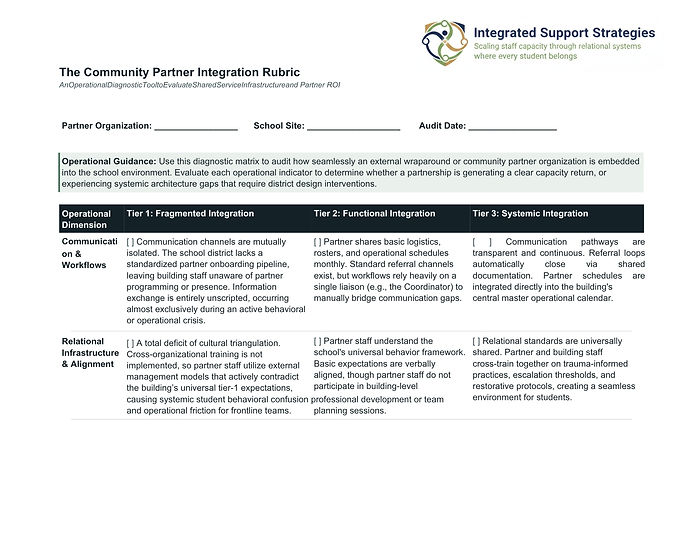
Serving as a concise, 1-page diagnostic matrix, The Community Partner Integration Rubric addresses this challenge by providing school principals, assistant principals, and community school coordinators with an accessible, high-impact auditing tool. Instead of relying on subjective opinions about a partner's value, this single-page framework allows leadership teams to quickly evaluate shared service infrastructure and pinpoint structural design gaps across core operational dimensions.
By evaluating partnerships across three distinct levels of integration—Fragmented, Functional, and Systemic—school leaders can move from reactive troubleshooting to strategic design interventions. This streamlined 1-page guide helps establish transparent communication pathways, align relational standards, and create a unified, seamless school environment for students and frontline staff alike.
Key Takeaways & Core Sections
-
Operational Guidance: A clear diagnostic protocol to evaluate whether external wraparound organizations are generating a high capacity return or experiencing systemic architecture gaps that require leadership intervention.
-
Communication & Workflows Evaluation: Diagnostic indicators assessing how information and referrals flow across three levels:
-
Tier 1 (Fragmented Integration): Isolated communication channels, unscripted information exchanges, and communication occurring primarily during active crises.
-
Tier 2 (Functional Integration): Basic monthly logistics sharing and standard referral channels that rely heavily on a single liaison.
-
Tier 3 (Systemic Integration): Transparent, continuous communication pathways, automated closed-loop referrals, and fully synchronized schedules.
-
-
Relational Infrastructure & Alignment Evaluation: Structured criteria evaluating cultural and behavioral alignment:
-
Tier 1 (Fragmented Integration): Lack of cross-organizational training, leading to external management models that contradict building-wide Tier 1 expectations.
-
Tier 2 (Functional Integration): Verbal alignment on basic expectations without joint participation in professional development or team planning.
-
Tier 3 (Systemic Integration): Universally shared relational standards, joint cross-training on trauma-informed practices and restorative protocols, and seamless operational execution.
-
Disclaimer: Integrated Support Strategies. For informational/educational use only; structures do not constitute formal legal counsel. Implementation, local policy compliance, and operational execution remain the sole liability of the using institution. Full terms of service below.
Maximize Your District's Relational Capacity
Downloadable resources provide immediate relief, but true operational transformation requires more than a template. Move your buildings past static documents and into lasting, systemic change. Let’s partner to architect an intentional, scalable structure built to sustain your multi-agency ecosystem.
Partner with us.