The Family Collaboration Guide
Moving Families from Passive Observers to Active Collaborators
Family engagement in schools often becomes reactive, occurring primarily when a student faces academic difficulty or behavioral challenges. When frontline staff only reach out during moments of crisis, families can feel defensive, alienated, or viewed as passive observers rather than essential partners in their child's education. Without a proactive communication strategy, building mutual trust between home and school becomes a constant uphill battle.
The Family Collaboration Guide addresses this challenge by acting as a macro-level operational roadmap that answers when and through what medium staff should reach out to families across the school year. Designed to work alongside our Families as Partners Relational Intelligence Guide, this framework equips all staff with a practical, script-based timeline to establish positive communication loops well before behavioral or academic friction arises.
By providing exact verbal talk-tracks, boundary-respecting check-ins, and a shared-expertise mindset, this resource transforms family outreach into a strategic asset. It enables school teams to position parents as the true experts on their children, unifying the support system around each student's success.
.jpg)
Key Takeaways & Core Sections
-
Target Audience: Targeted for all staff members across school and program sites seeking to build authentic family partnerships.
-
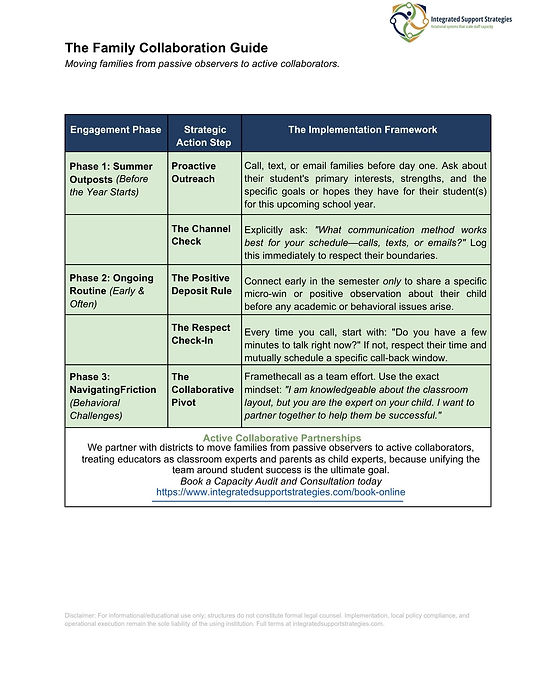
Phase 1: Summer Outposts (Before the Year Starts): Early outreach protocols to establish foundational trust before day one:
-
Proactive Outreach: Scripted guidance to connect via call, text, or email to ask about student interests, strengths, and primary family goals for the year.
-
The Channel Check: Exact language to confirm preferred communication methods (calls, texts, or emails) and respect family schedules.
-
-
Phase 2: Ongoing Routine (Early & Often): Sustained engagement strategies to keep communication channels open and positive:
-
The Positive Deposit Rule: Connecting early in the semester solely to share specific micro-wins or positive observations before any issues arise.
-
The Respect Check-In: A quick opening verbiage prompt ("Do you have a few minutes to talk right now?") to honor family boundaries and schedule mutually convenient callbacks.
-
-
Phase 3: Navigating Friction (Behavioral Challenges): A collaborative framework for addressing difficulties as a unified team:
-
The Collaborative Pivot: Explicit mindset framing that balances teacher expertise in classroom layout with family expertise as child experts ("I am knowledgeable about the classroom layout, but you are the expert on your child. I want to partner together to help them be successful.").
-
Disclaimer: Integrated Support Strategies. For informational/educational use only; structures do not constitute formal legal counsel. Implementation, local policy compliance, and operational execution remain the sole liability of the using institution. Full terms of service below.
Maximize Your District's Relational Capacity
Downloadable resources provide immediate relief, but true operational transformation requires more than a template. Move your buildings past static documents and into lasting, systemic change. Let’s partner to architect an intentional, scalable structure built to sustain your multi-agency ecosystem.
Partner with us.